

The Robot Arm Laser Welding Machine is a cutting-edge technology that has revolutionized the welding industry. With its advanced features and precise operation, it has become the go-to choice for many welding applications. Thanks to its robotic arm, it can work effortlessly in tight spaces and complex geometries, ensuring maximum efficiency and accuracy.
The machine's laser welding technology also brings multiple benefits to the table. It delivers high-quality welds with minimal or no distortion, leading to better product performance and overall durability. It is also energy-efficient, reducing electricity consumption and cost, and environmentally friendly, eliminating harmful emissions.
Furthermore, the robot arm laser welding machine is easy to maintain and operate, reducing downtime and increasing productivity. Its user-friendly interface and advanced controls make it ideal for both beginners and seasoned professionals.
In conclusion, the Robot Arm Laser Welding Machine is a game-changer in the welding industry, bringing improved efficiency, accuracy, and quality to manufacturing processes. Its advanced features, including the robotic arm and laser welding technology, make it an ideal choice for any welding application.
Wuhan Keyi Optic & Electric Technology Co., Ltd is a high-tech enterprise in Wuhan East Lake Hi-Tech Industrial Development Zone. We have a modernized manufacturing base and a high quality team; the scientific and technical personnel account 80% of the workforce, the number of senior technical staff accounts for 30%.
Over the years, our company has established partnerships with many domestic research institutes, insisting on the policy of scientific and technological innovation, customer satisfaction. Since foundation, with strict management and innovative spirit, we have successfully developed a number of advanced expertise; products include Diode-pumped laser machine, CO2 laser machine, fiber laser machine series, laser welding machine, laser cutting machine, Currently, our products have been exported to Thailand, Brazil,German,Pakistan,Korean,etc. and widely used in electronic components, manufacturing, machinery, internal combustion engines, auto parts, medicine, food, household industrial and defense industries.
Why Choose Us
1.High quality
Our products are manufactured or executed to very high standards, using the finest materials and manufacturing processes.
2.Professional team
Our professional team collaborate and communicate effectively with one another, and are committed to delivering high-quality results. They are capable of handling complex challenges and projects that require their specialized expertise and experience.
3.Long warranty
The long-term warranty is designed to give consumers more confidence that their purchases and services will continue to be valid.
4.Rich experience
Dedicated to strict quality control and attentive customer service, our experienced staff is always available to discuss your requirements and ensure complete customer satisfaction.


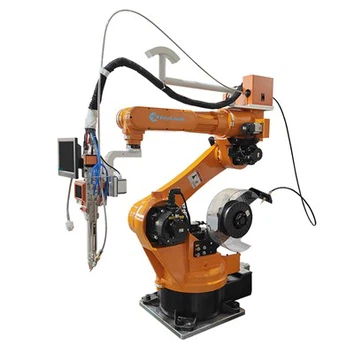


What is Robot Arm Laser Welding Machine
The robot arm laser welding machine is a cutting-edge technology that has revolutionized the welding industry. With its advanced features and precise operation, it has become the go-to choice for many welding applications. Thanks to its robotic arm, it can work effortlessly in tight spaces and complex geometries, ensuring maximum efficiency and accuracy.
Benefits of Robot Arm Laser Welding Machine
Consistency
One of the factors that affect consistency in manual welding is distortion of weld by heat. Robotic welders offer precision during welding. This minimizes the number of weld passes needed to complete a task, which reduces heating from the surrounding metal that can distort the final product.
Robotic and laser welding ensures that you can repeat a task and achieve the same consistency each time, unlike in manual welding where consistency and repeatability requires a high skill set and extreme concentration. The consistency you achieve is useful, especially in mass production as you can guarantee your clients’ uniformity. Robotic welding allows you to perform repetitive tasks without the risk of human error.
Efficiency and quality
Robotic welding systems help you speed up your output. They also perform tasks with high accuracy, eliminating the need to repeat tasks, which wastes time. Unlike manual welding, which relies on human laborers, robotic systems do not stop for breaks, vacations or sick days. Once you master the settings and programming needed for each weld, you can run the systems around the clock, allowing you to increase productivity and meet client deadlines with ease. Robotic systems also perform precisely with minimal splattering reducing the time spent cleaning up after a job. Overall, they improve customer satisfaction as you can deliver on tasks faster, improving your reputation, and gradually, your bottom line.
Conservation of raw materials
Laborers in manual welding often make mistakes that result in wastage of material and power. When using robotic welding, you regulate everything including the power, allowing you to conserve energy. Robotic systems run consistently over a long time, reducing the frequency of equipment start-ups, which also saves power.
Safety and labor saving
Welding exposes workers to risks such as toxic gases, fumes, electric shocks and weld flash burns. Robotic welding systems allow supervision from a distance reducing exposure to these risks. You also have fewer employees working around the welding area, minimizing the possibility of accidents.
The only significant cost you incur when operating robotic welding systems is the initial cost of purchasing the equipment, thereafter, you only need to spend on routine maintenance and repair. Additionally, robotic systems do not require insurance schemes, accident compensation, insurance policies and overtime pay among others unlike manual welding. You also save on expenses such as finding the right welders and training them to suit your business.
Cost saving
Robotic systems improve efficiency, which saves you time, resources, and reduces operational costs. Through robotics, you increase consistency, productivity and deliver better quality. Other costs saving opportunities include reduced compensation for workers and energy saving costs. Cost saving cuts the cost of production, subsequently reducing the overall cost of the product, giving you a competitive advantage when sending quotations to clients.
How Does Robot Arm Laser Welding Machine Work

Robots are often thought of as being synonymous with automation. Welding robots, in particular, incorporate an arm that is capable of moving in three dimensions and welding metals together. There is a wire feeder that sends a filler wire to the robot, and a high-heat torch towards the end of the arm that melts metals during the welding process.
Some certified human operators are employed to maintain these robots and give them instructions. There is a control box, which the operator uses to control the robot’s programs, and an operation box that helps to start the operation.
The robotic arm's tool warms up to melt metal and connect the components. A wire feeder supplies extra metal wire to the arm and torch as needed. When it's time to weld the next portion, the arm moves the torch to the cleaner to clear any metal splatters off the arm that may otherwise freeze in place. Moreover, there are arc shields which are capable of preventing the high heat arc from mixing with the oxygen to protect the workers and the nearby locations.
The 7 Most Common Types of Robot Arm Laser Welding Machine Processes
Welding is an art as well as a science that requires a high level of training. However, there are quite a few professionals who are unable to meet these qualifications. Therefore, in today's world, robotic automation is the new normal. There is a wide range of machinery available and robots adapt to a variety of welding processes, including:
Arc welding
The arc method is one of the most common forms of robotic welding. An electric arc produces high heat, up to 6,500 degrees Fahrenheit, which melts the metal in this process. Molten metal joins parts together, which solidifies into a secure bond after cooling. When a project necessitates a vast number of precisely linked metals, arc welding is a great option.
Resistance welding
Robots may employ resistance welding when tasks require heat treatment or a cost-cutting measure. A stream of electricity forms a pool of molten metal as it flows between the two metal bases throughout this operation. This molten metal is what holds the metal components together.
Spot welding
Some materials are resistant to electrical currents, making them unsuitable for other types of welding. This is a common occurrence in the automotive industry while putting together sections of a vehicle's body. Robotic welders solve the problem by joining two thin metal sheets in a single area using a version of resistance welding.
Tig welding
TIG welding may be required for robot welding applications that need a high level of accuracy. Gas tungsten arc welding, or GTAW, is another name for this technique. An electric arc forms between a tungsten electrode and the metal base.
Mig welding
Gas metal arc welding, often known as GMAW or MIG, is a simple and quick process that produces a lot of deposition. A wire is repeatedly moved to the welder's heated tip, which melts it and allows a considerable amount of molten metal to drip onto the base for attaching it to another component.
Laser welding
Laser welding is the ideal method of metal joining for projects that demand precision for a large number of pieces. Laser welding is frequently used on small pieces, such as jewellery or medical components.
Plasma welding
Because the operator may quickly modify both the speed of gas travelling through the nozzle and the temperature, plasma welding provides the most versatility.
Components of Robot Arm Laser Welding Machine
The robot - This is a 6-axis articulated manipulator driven by a servo motor. It comprises drives, transmission mechanisms, robotic arms, joints, and internal sensors. Its primary function is to accurately position and move the manipulator (welding head) to achieve the desired posture and movement trajectory.
Robot control cabinet - Serving as the nerve center of the system, the control cabinet contains computer hardware, software, and specialized circuits. It processes all information during robot operation and controls its actions.
Welding power switch - This includes the welding power supply and a specialized welding gun.
Welding sensor and safety protection facilities - These components ensure the safety of the welding process.
Welding fixture - A fixture is used to hold the workpiece securely during welding.
Characteristics of Robot Arm Laser Welding Machine
Non-contact
The laser can form a minimum point diameter of 0.1mm, enabling the welding of micro-spacing package components. The minimum tin feeding device can be as small as 0.2mm.
01
Minimal thermal impact
Provides short-time local heating, resulting in minimal thermal impact on the substrate and surrounding parts. This ensures -quality solder joints.
02
No consumables
Laser welding does not require soldering head consumption or heater replacement, allowing for continuous operation with high efficiency.
03
Ideal for lead-free welding
Laser welding minimizes the occurrence of solder joint cracks during lead-free welding.
04
Non-contact temperature measurement
The surface temperature of the welding material is measured using a non-contact method, eliminating the need for direct contact with the welding head.
05
Robot Arm Laser Welding Machine Application Fields

The shape of the workpiece is becoming more and more complex, and the quality requirements for welding are getting higher and higher. Many manufacturers have begun to use welding robots to deal with these difficult processes. Robot arm laser welding machines have relatively low environmental requirements, and the processing area can be infinitely expanded, which can meet the welding needs of complex structural parts.
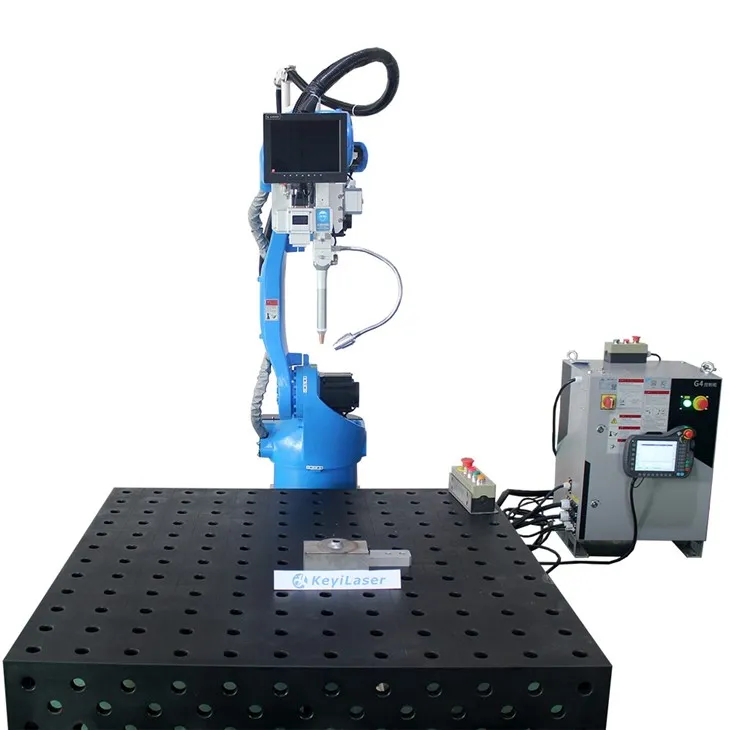
Robot arm laser welding machines are widely used, including sheet metal processing, automobiles, kitchen equipment and electronic engineering, medical treatment or mold manufacturing industries. In addition to laser welding, laser brazing, laser cold and hot wire feed welding and laser hybrid welding have also greatly expanded the application fields of laser. Due to its unique flexibility and production efficiency, laser processing has become a unique process in each production link.

The above is the wide range of uses of robot arm laser welding machines. Robot arm laser welding machines play an important role in laser automation. They can imitate certain motion functions of human arms and complete difficult welding procedures. It can replace people's heavy physical labor, realize the mechanization and automation of production, complete operations in harmful environments, and protect personal safety.
How to Maintain Robot Arm Laser Welding Machine
Check for liquids and spatter. Look for signs of liquids on the floor or on the machine. This is an indication that you may have a loose or broken fitting. It also might indicate damaged hoses or hard tubing.
Any exposed hoses are going to be subjected to strong ultraviolet (UV) light from the welding process, which will typically break down the materials in most flexible hoses over time.
The same holds true for the protective coating of electrical wires. They, too, will break down and crack with exposure to UV light. They also could be subjected to high heat and weld spatter. Some inexpensive covers such as fabric sheaths can be used to extend the life of your flexible hoses without restricting their movement. These covers should be considered for hoses routed through and on the robot and also for end-of-arm tooling or fixed-tooling stations.
The buildup of spatter over time can degrade or destroy your air and hydraulic clamps. There is also the risk of spatter or slag burning a hole through the tubing, causing a possible fire hazard. Extra consideration is needed when the hydraulic tooling is under high pressure. A small pinhole under pressure can cause a lot of damage to the surrounding area when ignited. And, yes, I’m speaking from experience.
Along the same lines, there have been great improvements in hydraulic fluid that is more fire-resistant than standard fluid and should be considered for such an application.
Visually check the robot hardware. As you continue into the workcell, visually inspect the hardware on the robot and the surrounding tooling for signs of loose or missing bolts. Visually identify and verify that any applicable safety covers are in place. If your robot has gearboxes that use oil instead of grease, they may have a sight glass that can be used for a quick inspection of fluid level and colour. Things to look for are low fluid level, which indicates a leak, and darker fluid colour, which indicates either high temperatures or contamination.
Check the grease in the robot and positioner gearboxes. Look at the level and colour of the grease; a dark colour suggests high heat or contamination.
Aurally check for leaks. Next, if possible, listen for air leaks in the cell. This, too, could be an indicator of an air line with a burn hole or a fitting that has worked its way loose. And, if possible, listen to the equipment while running production. Grinding noises or unusal vibrations may be an indicator of a mechanical problem.
Check the master position. The final item I would include on my daily inspection would be the robot master position and corresponding User Tool values to validate everything is located properly and accurately before starting production. There are some tools available that can perform these functions automatically on a set interval, for example, after every part.
Check the grease in the robot and positioner gearboxes. Again, look at the level and colour of the grease; a dark colour suggests high heat or contamination.
Check the batteries. If your robot uses batteries to back up the robot position or programs, you will need to replace them regularly, usually yearly.
Check for cleanliness. While you are inside the robot control cabinet, be sure all the fans and fan ducts are clean of debris. Also, verify the inside of the control cabinet is clean. If it is not, you may be missing some covers on cable entries or a door seal may be damaged. If your robot is in a fabrication shop where cutting and grinding operations are nearby, you will especially want to make sure those airborne contaminants don’t get inside the controller and onto exposed circuit boards. The dust and oil can lead to a short or, worse, a fire.
Back up your software. Make it a habit to back up your robot software regularly. With the complexity of today’s robot systems it is easy to get into trouble quickly with a few bad programming techniques that could potentially shut down production for long periods of time. By restoring a previous working backup software package, that robot can return to production much quicker.
Check the welding leads. Be sure to check the cable condition and pay special attention to the connection points. If the connection points are loose or the cable strands are showing signs of wear, this will add resistance to the overall system and not only affect weld performance, but will also cause the cables to generate more heat. If you use rotary grounds, verify they are properly lubed with conductive grease.
Check for cleanliness. Similar to the robot, if the factory environment has machining or grinding processes nearby, make sure the cooling system for the power supply and possibly the welding torch are clean and able to exchange heat efficiently.
Check coolant levels. If you are using a water cooler for your welding process, verify the fluid levels and clarity of water or cooling fluid. If not maintained properly, the water or coolant can grow algae, which will in turn diminish the cooling performance of the system. This will shorten the life of the components.
Check gas connections. In welding applications where a shielding gas is present, it’s good practice to occasionally check all the gas connections and fittings for leaks, and validate that pressure and flow are within your specified limits. Too much gas flow can be just as detrimental to the weld process as too little.
Check your consumables. Consumables to check include wire guide rolls, wire delivery systems, torch liners, tips, nozzles, and diffusers. The condition of these items will all vary based on usage, as will the frequency of when they need to be addressed. General recommendations for that frequency can be obtained from the welding equipment supplier.
Certifications


Our Factory
Our industrial laser equipment is sold in various regions around the world including North America, Europe, Asia-Pacific, and Latin America. We have achieved significant success in these markets due to our high-quality equipment and exceptional customer service. Our team of experienced sales professionals work closely with our clients to understand their specific needs and provide them with customized solutions that meet their requirements. Our extensive portfolio of industrial laser equipment includes laser cutting and welding systems, marking and engraving machines, and additive manufacturing systems. We pride ourselves on delivering the best products and services to our customers, helping them to improve their manufacturing processes and increase productivity.

FAQ
Q: What is a robot arm laser welding machine?
Q: What industries commonly use robot arm laser welding?
Q: What advantages do robot arm laser welding systems offer over manual welding?
Q: What types of materials can be welded with a robot arm laser welding machine?
Q: How accurate are robot arm laser welding systems?
Q: Can a robot arm laser welding system be integrated into existing production line?
Q: What training is necessary to operate a robot arm laser welding system?
Q: How fast can a robot arm laser welding system work?
Q: Are robot arm laser welding systems capable of continuous operation?
Q: Can a robot arm laser welding system be used for complex welding patterns?
Q: What safety measures are required when using a robot arm laser welding machine?
Q: How is the laser beam focused during welding?
Q: What factors affect the quality of a laser weld?
Q: Can a robot arm laser welding system be customized for specific tasks?
Q: How is the laser source maintained?
Q: What is the typical return on investment (ROI) for a robot arm laser welding system?
Q: Can a robot arm laser welding system handle small parts?
Q: What is the average lifespan of a laser source in a robot arm laser welding system?
Q: Can a robot arm laser welding system be easily upgraded or modified?
Q: Can a robot arm laser welding system be used for additive manufacturing?
We're professional robot arm laser welding machine manufacturers and suppliers in China, specialized in providing high quality customized service. We warmly welcome you to wholesale robot arm laser welding machine made in China here from our factory. For price consultation, contact us.
Flying UV Laser Marking Machine for Glass And Plastic, 200W Fiber Laser Marking Machine with Enclose Covery, UV Laser Engraver for Marking Glass And Silicon